PWM Pressure
Pulse-width movement tuned for animated bass, hoover leads, and cutting harmonic motion.
'%20stroke-linecap='round'%20stroke-linejoin='round'%3e%3cg%20id='wordmark-letters'%20stroke='%23f2eee6'%20stroke-width='2.15'%3e%3cpath%20id='P'%20d='M14.4%2041.4V31.0H24.2C27.0%2031.0%2028.5%2031.9%2028.5%2034.1C28.5%2036.2%2027.0%2037.1%2024.2%2037.1H14.4'/%3e%3cpath%20id='L'%20d='M33.3%2031.0V41.4H43.8'/%3e%3cpath%20id='A-1'%20d='M51.0%2041.4L58.5%2031.0L66.0%2041.4'/%3e%3cpath%20id='S'%20d='M83.0%2031.0H73.5C70.9%2031.0%2069.8%2032.0%2069.8%2034.0C69.8%2036.0%2070.9%2036.7%2073.6%2036.7H79.5C82.3%2036.7%2083.5%2037.3%2083.5%2039.0C83.5%2040.7%2082.2%2041.4%2079.4%2041.4H70.0'/%3e%3cpath%20id='M'%20d='M90.5%2041.4V31.0L96.5%2036.6L102.5%2031.0V41.4'/%3e%3cpath%20id='A-2'%20d='M110.8%2041.4L118.3%2031.0L125.8%2041.4'/%3e%3cpath%20id='C-1'%20d='M162.8%2031.0H154.1C151.3%2031.0%20149.9%2032.6%20149.9%2036.2C149.9%2039.8%20151.3%2041.4%20154.1%2041.4H162.8'/%3e%3cpath%20id='I-1'%20d='M171.0%2031.0V41.4'/%3e%3cpath%20id='R'%20d='M179.2%2041.4V31.0H188.7C191.6%2031.0%20193.0%2031.9%20193.0%2034.1C193.0%2036.2%20191.6%2037.1%20188.7%2037.1H179.2M188.0%2037.1L194.2%2041.4'/%3e%3cpath%20id='C-2'%20d='M209.2%2031.0H200.5C197.7%2031.0%20196.3%2032.6%20196.3%2036.2C196.3%2039.8%20197.7%2041.4%20200.5%2041.4H209.2'/%3e%3cpath%20id='U'%20d='M217.2%2031.0V37.0C217.2%2040.2%20218.8%2041.4%20222.2%2041.4H223.3C226.7%2041.4%20228.3%2040.2%20228.3%2037.0V31.0'/%3e%3cpath%20id='I-2'%20d='M236.0%2031.0V41.4'/%3e%3cpath%20id='T'%20d='M244.1%2031.0H254.5M249.3%2031.0V41.4'/%3e%3c/g%3e%3cg%20id='signal-connector'%20stroke-width='1.15'%3e%3ccircle%20cx='130.2'%20cy='36.2'%20r='1.75'%20stroke='%23f2eee6'%20stroke-width='1.15'/%3e%3cpath%20d='M133.3%2036.2H144.3'%20stroke='%2324cfff'/%3e%3cpath%20d='M147.0%2036.2H150.8'%20stroke='%239a968d'%20stroke-opacity='0.72'/%3e%3c/g%3e%3c/g%3e%3c/svg%3e) Join
JoinClassic circuits / modern engines
A DCO synthesizer emulation of the Roland Alpha Juno 2 — the instrument behind the original hoover sound — covering the Alpha Juno 1 and MKS-50 by extension. Built around hoover pressure, PWM motion, and chorus-driven bite.
First builds: Windows, VST3 and CLAP. Dimmed formats are planned, not released.
In development
Hoovr Core starts with the sounds producers actually chase: the hoover lead that defined rave and hardcore, biting PWM movement, chorus width, and the immediate response of a classic DCO instrument. Because the Alpha Juno 1, the Alpha Juno 2 and the rack-mount MKS-50 share the same voice architecture, one engine covers all three. The goal is not nostalgia as decoration. The goal is behavior, pressure, and feel.
Why this synth
The hoover is not a sound designer's invention. It is "What The?", a factory preset that shipped inside the Roland Alpha Juno — a stacked, detuned PWM sawtooth with a hard filter sweep, sitting on the same voice architecture as the Alpha Juno 1 and the MKS-50. Producers found it, pitched it, mangled it, and built entire genres on top of it.
That preset and the patches derived from it ran through rave, hardcore, gabber, drum and bass, and the early Prodigy records. Thirty years later people are still chasing it — and still settling for sample packs, because getting the real thing means finding the hardware.
Hoovr Core exists for exactly that reason. The goal is not "inspired by". The goal is that "What The?" and everything derived from it sound the way they sound on the original instrument.
The blind A/B test will compare recordings of an original Alpha Juno against Hoovr Core. No hints, no waveform tells, no marketing safety net. Just ears.
Audio slots prepared. Final clips will be added when the model is ready.
Hoovr Core is being shaped around specific behavior: pulse-width response, chorus movement, DCO stability, and the way classic control ranges push a patch into the right place quickly.
Pulse-width movement tuned for animated bass, hoover leads, and cutting harmonic motion.
A focused chorus character designed around width, bite, smear, and the unmistakable push of classic hardware.
Architecture-first modeling that cares about response, ranges, and feel before decoration.
A modern instrument surface for fast patching, preset movement, automation, and repeatable production work.
Signal architecture
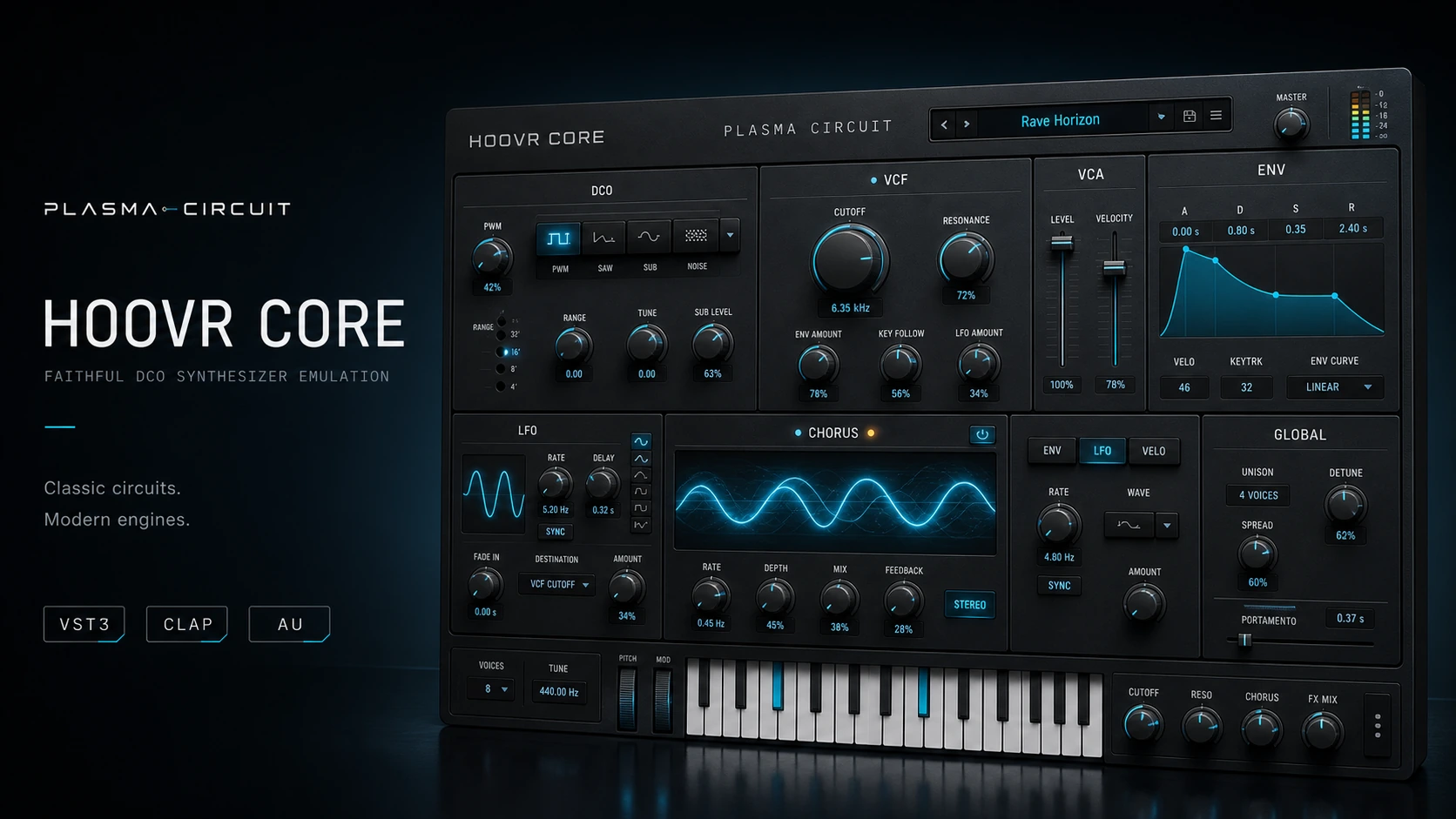
The interface keeps the instrument immediate: oscillator, filter, envelope, chorus, performance, and patch movement stay visible at a glance, so sound design stays tactile, fast, and readable.
The first Hoovr Core builds target Windows in VST3 and CLAP. macOS, Linux, AU and LV2 are on the roadmap and are shown dimmed below until they ship.
Some engines should be announced. Others should be heard about before they are seen.
Plasma Circuit is a boutique audio software studio focused on meticulous recreations and modern extensions of classic electronic instruments. The first release is narrow by design: get the Alpha Juno core right, then let the engine grow. Questions and press enquiries: info@plasmacircuit.com.
Join for launch notice, possible intro discounts, and the A/B test when the final clips are ready.